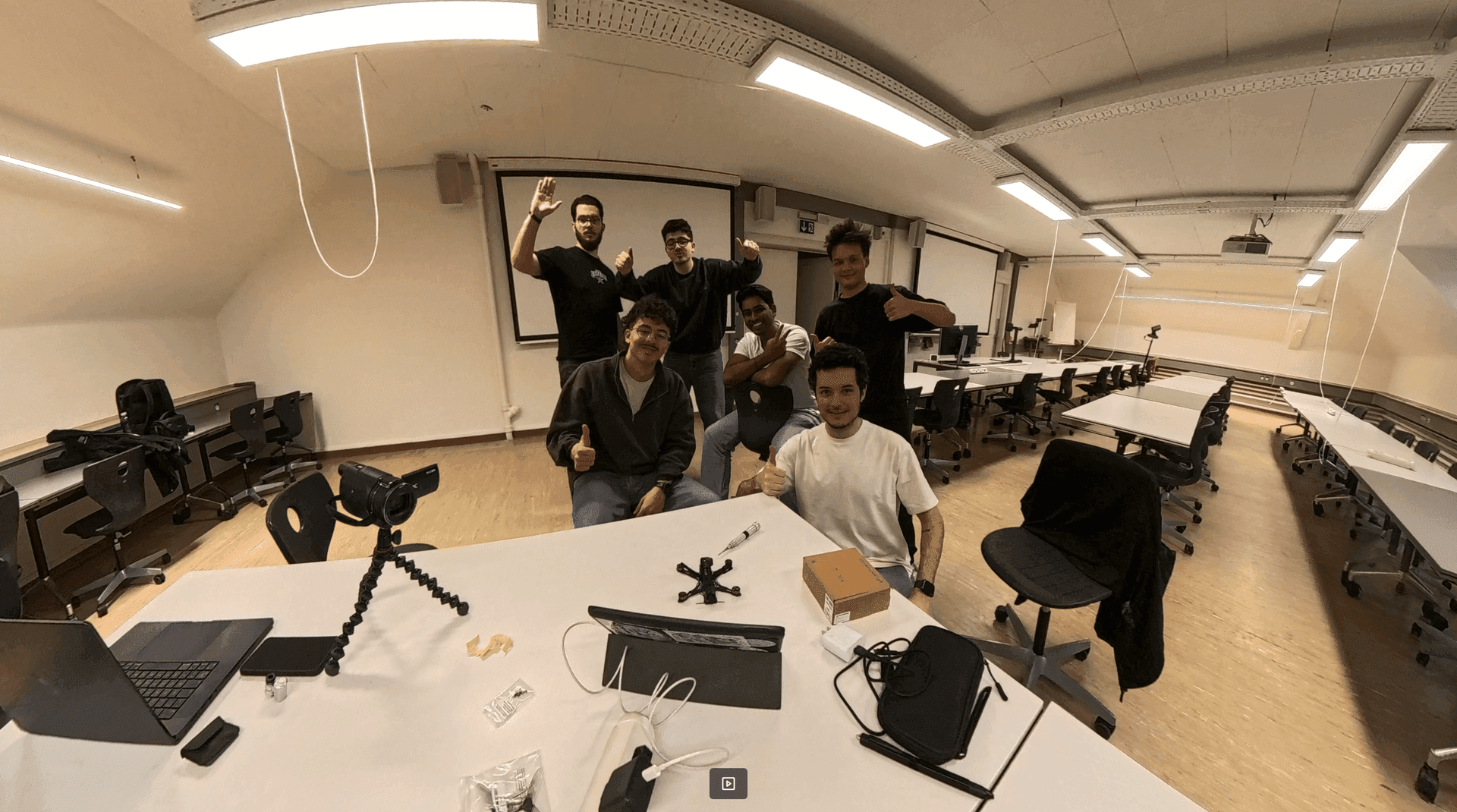
We are a team of informatics students from ZHAW (Zurich University of Applied Sciences), and this semester we are building something we are genuinely excited about: a fully autonomous drone system, from firmware to flight.
This blog will document our entire journey — from the first lines of code to (hopefully) a drone that can fly itself. Each post will give you an honest look at what we are working on, the decisions we make, the problems we run into, and how we solve them. You can expect updates on our development process, technical architecture, testing and experimentation, and lessons learned along the way. We will also share videos and demos as things come together.
Our goal is not just to build a working system, but to document the process in a way that others can learn from. Think of this blog as a living journal — showing how ideas evolve into real implementations.
The Project: LionBee Drone Autonomy Platform
At the heart of this project is the NewBeeDrone LionBee 3-inch Developer Kit — an open-hardware micro long-range FPV drone built around an AT32F435 flight controller. The board comes with an impressive set of integrated sensors: a GPS module (M10Q), barometer (SPL06), IMU (ICM42688P), and an ExpressLRS receiver based on the SX1280 chip. It is compact, capable, and, crucially for a student project, fully open hardware.
The project is structured into four incremental phases, each delivering a working milestone:
Phase 1 – Firmware & Simulation Foundation:
Flashing the open-source iNav firmware onto the LionBee and setting up a Software-in-the-Loop (SITL) simulation environment using Gazebo. The goal is to be able to test the full flight stack in simulation before any real-world flights.
Phase 2 – Remote Control & Waypoint Navigation API:
Building a Python-based ground control API that communicates with the drone via MSP or MAVLink telemetry — working identically against both the simulation and the real hardware.
Phase 3 – Agile Trajectory Planning & Sensor Fusion:
Implementing smooth, dynamic flight path generation and fusing data from all onboard sensors using an Extended Kalman Filter for robust state estimation.
Phase 4 – Stretch Goals:
Exploring AI-based autopilot models in simulation and extending the platform to support coordinated multi-drone flight.
The team is split into a Hardware team and a Software team, working in parallel on their respective challenges. The hardware team owns firmware bring-up and board configuration; the software team focuses on simulation, communication protocols, and the control API.
We are excited to kick this off and share it with you. Stay tuned — our first real development update is already on its way.
— The SudoFly Team